Intelligence · Litigation
Crown Coins Casino Faces Two Ohio Loss-Recovery Suits
Crown Coins Casino operator Sunflower Ltd. faces a second Ohio class action in six months, naming N.D. Ohio and specific loss-recovery statute sections.
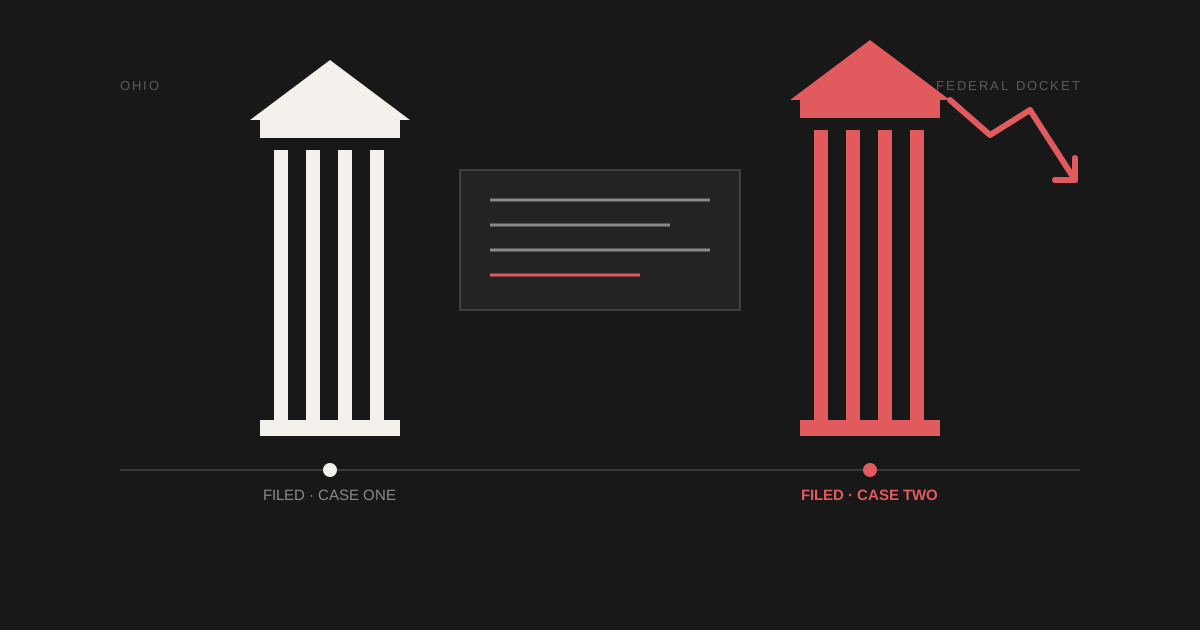
Sunflower Ltd., the operator behind Crown Coins Casino, is fighting the same legal fight twice in Ohio at once. A class action filed August 22, 2025 put the company's dual-currency structure in front of an unspecified Ohio court. Six months later, on February 27, 2026, a second class action landed in the U.S. District Court for the Northern District of Ohio — this one built around specific sections of the Ohio Revised Code. Same operator, same theory of harm, and now two active dockets running at once.
Two suits, one operator, one theory
The case that started it, McNamara v. Sunflower Ltd. (Crown Coins Casino), was filed August 22, 2025, as a class action. The court of filing is not confirmed in the record SweepsMonitor has reviewed — we are saying that plainly rather than guessing at a venue. What is clear from the complaint as reported is the underlying legal theory: that Ohio's loss-recovery statute applies to Crown Coins Casino's dual-currency model, and that players who lost money through that model are entitled to recover it. That claim is alleged, not established. No court has yet ruled on whether the statute reaches a sweepstakes-style dual-currency product at all.
The second case, Drollinger v. Sunflower Ltd. (Crown Coins Casino), was filed February 27, 2026, roughly six months after McNamara, in the U.S. District Court for the Northern District of Ohio under docket number 1:26-cv-00210. It is also a class action, and it targets the same operator group over the same category of conduct. But it is procedurally more specific than the first suit in a way that matters: the complaint cites Ohio Revised Code §§3763.02 and 3763.04 directly, rather than referencing the state's loss-recovery framework in general terms. Like McNamara, the claims in Drollinger are allegations. Nothing about the statute's applicability to Crown Coins Casino has been adjudicated.
Why the second complaint reads differently
A second lawsuit against the same operator, over the same core question, six months after the first is not itself unusual in contested-legality litigation — multiple plaintiffs' firms often test the same theory against the same defendant in parallel or sequential filings. What stands out here is the shape of the second complaint. Drollinger names a specific federal court, N.D. Ohio, and pleads specific statute sections, ORC §§3763.02 and 3763.04, rather than characterizing the claim more generally the way the record shows McNamara did.
That kind of specificity in a follow-on complaint is typically a sign that plaintiffs' counsel is narrowing the pleading to survive an early motion to dismiss, or building a cleaner record on a legal theory that a prior filing left more open-ended. Neither of those explanations is confirmed here — SweepsMonitor has not seen filings stating why Drollinger was brought the way it was, and we are not going to infer motive beyond what the docket itself shows: a more specific, statute-anchored complaint filed in a named federal court, months after a less procedurally detailed first suit against the same company.
What Ohio's loss-recovery framework covers
Ohio, like a number of states, has a statutory framework that allows recovery of money lost through gambling activity. The two Crown Coins Casino suits both turn on the same threshold question: whether a sweepstakes-casino platform's dual-currency structure — a free-to-play currency paired with a second, prize-redeemable currency marketed as a no-purchase-necessary sweepstakes entry — counts as the kind of loss the statute was written to address. That is a live legal question, not a settled one. Ohio courts have not, as far as this record shows, issued a ruling squarely resolving whether a dual-currency sweepstakes model triggers loss-recovery liability.
This is part of a broader pattern SweepsMonitor has tracked across multiple states: private plaintiffs using older loss-recovery statutes as a civil litigation vehicle against sweepstakes-casino operators, distinct from any state regulator's administrative posture. Ohio's statute functions the same way procedurally as similar laws elsewhere — it gives an individual plaintiff, not a regulator, a direct civil claim to pursue in court. Whether that vehicle actually reaches a dual-currency sweepstakes product is being tested case by case, state by state, and Crown Coins Casino's two Ohio suits are one instance of a pattern playing out with other operators in other jurisdictions as well.
What's actually different between the two filings
Beyond the six-month gap, three things distinguish Drollinger from McNamara on the record as reported. First, forum: Drollinger names a specific federal court, N.D. Ohio, while the court in McNamara is not confirmed. Second, statutory specificity: Drollinger cites ORC §§3763.02 and 3763.04 directly; McNamara is described in terms of the loss-recovery statute generally, without those section numbers appearing in the reporting SweepsMonitor has reviewed. Third, docket identification: Drollinger carries a specific case number, 1:26-cv-00210, giving it an immediately trackable federal record in a way the first suit's public reporting does not yet show.
None of those distinctions changes what's actually alleged. Both suits claim the same core thing — that Crown Coins Casino's dual-currency model falls under Ohio's loss-recovery statute and that class members are entitled to recover losses. The difference is procedural packaging, not a different legal theory. Two lawsuits testing the same theory against the same defendant, with the second one built more precisely, is consistent with plaintiffs' counsel refining an approach rather than raising a new claim.
What we know / what remains unclear
What we know: two class actions have been filed against Sunflower Ltd. over Crown Coins Casino in Ohio — McNamara, filed August 22, 2025, and Drollinger, filed February 27, 2026, in the U.S. District Court for the Northern District of Ohio under docket 1:26-cv-00210. We know Drollinger cites ORC §§3763.02 and 3763.04 specifically. We know both suits allege that Crown Coins Casino's dual-currency model is subject to Ohio's loss-recovery framework. We know neither case has reached a resolved outcome — no settlement, dismissal, or verdict has been reported in either.
What remains unclear: the exact court in which McNamara was filed is not confirmed in the record we have reviewed. Whether the two cases will be consolidated, coordinated, or proceed on entirely separate tracks is not established. Whether either case will be certified as a class action is undetermined. And the central legal question both suits raise — whether Ohio's loss-recovery statute actually reaches a dual-currency sweepstakes product — has not been ruled on by any court in either matter. We are not going to predict how either case resolves.
Why two suits change the exposure calculus
A single lawsuit testing a novel statutory theory against a sweepstakes operator is one data point. Two suits against the same operator, over the same theory, filed months apart in what appears to be an escalating procedural posture, is a different kind of signal — not proof of liability, but evidence that more than one plaintiffs' firm sees Ohio's loss-recovery statute as a viable vehicle against this specific business model. That matters for how Crown Coins Casino, and by extension other operators using a comparable dual-currency structure, have to think about litigation risk in Ohio specifically.
It also means any eventual ruling in one case doesn't necessarily resolve the other. A dismissal, a class-certification decision, or a ruling on the statute's applicability in Drollinger's federal docket would be persuasive, but it wouldn't automatically bind whatever court is hearing McNamara if that case proceeds on a separate track in a different venue. Two live dockets on the same theory means two separate chances for a court to weigh in — and two separate risks of inconsistent outcomes until one or both are resolved.
Reading the two case captions side by side
Case captions are a small detail that can carry real information, and these two are worth reading closely. Both name Sunflower Ltd. directly, with Crown Coins Casino identified parenthetically as the operating brand — a structure that puts the corporate entity, not just the consumer-facing product, on notice in both filings. That's consistent with how plaintiffs typically approach litigation against an operator running a branded platform through a separate corporate holder: naming the entity that actually controls the money, the terms of service, and the underlying business decisions, rather than suing a brand name that has no independent legal existence.
The plaintiffs themselves, McNamara and Drollinger, are not confirmed by SweepsMonitor to be related, connected, or coordinated in any way beyond both having brought class claims against the same operator over the same statutory theory. Nothing in the record we've reviewed indicates the same law firm filed both suits, or that the two cases are being pursued as part of a single coordinated strategy. Treating them as a single undifferentiated "lawsuit" would understate what's actually happening: two independent legal actions, six months apart, converging on the same legal question about the same company.
What's not yet in the public record
A responsible account of this story has to be as clear about its gaps as its facts. SweepsMonitor has not seen, and is not asserting the existence of, any answer filed by Sunflower Ltd. in either case, any scheduling order setting a trial or hearing date, any motion practice beyond the filing of the complaints themselves, or any indication of settlement talks in either matter. We also have not seen reporting establishing whether Crown Coins Casino has issued any public statement responding to either suit. Absent that reporting, we're not filling the gap with speculation about the company's position or strategy.
Similarly, we have not seen a ruling, order, or filing that resolves the exact court hosting McNamara. Ohio has both state common pleas courts and federal district courts that could plausibly host a class action against a company operating a nationally accessible platform, and without a confirmed docket citation for that case, SweepsMonitor is not going to guess at the venue. That gap is itself part of the story: two suits against the same operator, and only one of them currently traceable to a specific, citable federal docket number.
What SweepsMonitor is watching next
We're tracking docket activity in both cases: any motion to dismiss and how it's briefed and decided, any ruling on class certification, and — most importantly — any decision that squarely addresses whether Ohio's loss-recovery statute applies to a dual-currency sweepstakes model. We're also watching for confirmation of the court in which McNamara was actually filed, since that detail remains unresolved in the reporting available to us.
Separately, we're watching whether the two cases get consolidated or coordinated, whether additional Ohio plaintiffs file similar claims against Crown Coins Casino or other operators, and whether this pattern of loss-recovery litigation continues to expand into new states. Each development will be reported against its own docket, not folded into a general narrative about the sector's litigation exposure.
Public record: SweepsMonitor identified McNamara v. Sunflower Ltd. (Crown Coins Casino) and Drollinger v. Sunflower Ltd. (Crown Coins Casino), N.D. Ohio, 1:26-cv-00210, through its review of the public case record and reporting leads. The site does not link readers to third-party coverage.