Intelligence · Litigation
Baltimore Tests Municipal Power Against Social Casinos
Baltimore is suing social-casino operators under city consumer-protection authority, not state gambling law — a jurisdictional theory with real limits.
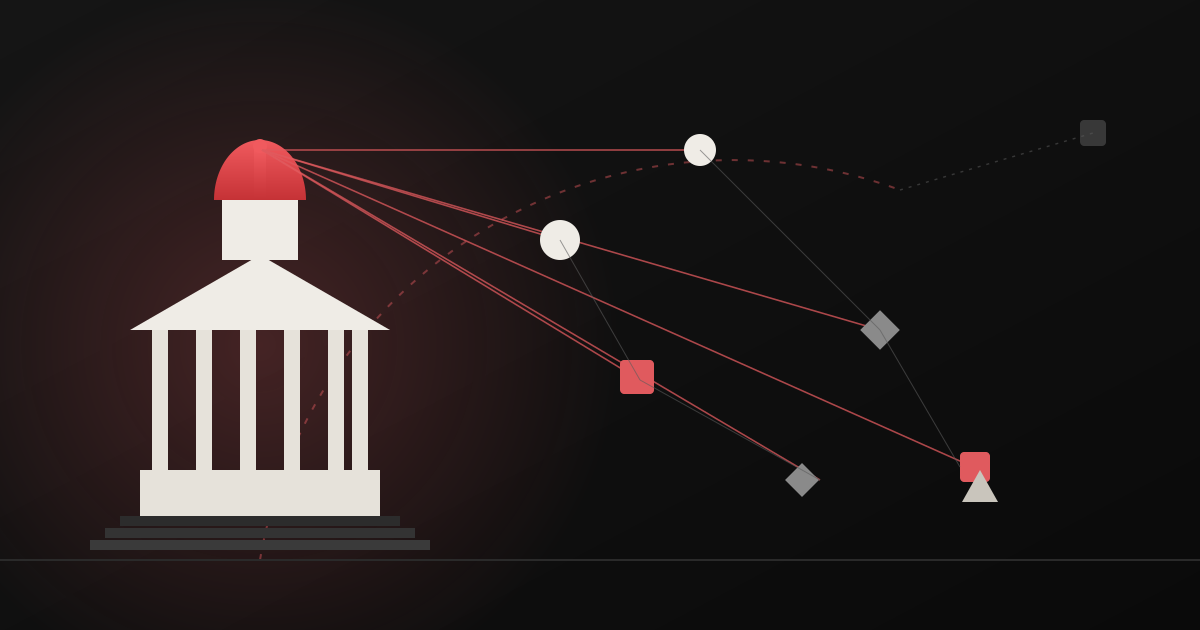
Baltimore is suing social-casino operators — and it's doing it as a city, not as a state. That's the detail worth sitting with before any other. Social-casino litigation in the United States has, until now, run almost entirely through state attorneys general and state gambling or sweepstakes statutes. Baltimore's case, announced by the plaintiffs' firm DiCello Levitt, brings a municipal consumer-protection theory to a sector that has mostly been fought over in state capitals — and it names payment, KYC, and marketing participants alongside the consumer-facing operators, testing how far a city's enforcement reach actually extends into an operator's supporting infrastructure.
A city in the plaintiff's chair
Municipal governments don't often sue national industries. Cities enforce building codes, business licensing, and local nuisance ordinances; they rarely position themselves as the lead plaintiff against an entire product category with a national customer base. That's what makes Baltimore's approach here notable on its face, independent of how the underlying claims eventually fare in court: a city is asserting that its own consumer-protection authority — not just the state's — gives it standing and cause to act against social-casino operators.
The distinction between a state attorney general's office and a municipal government matters beyond who signs the complaint. State AGs typically enforce statewide unfair-and-deceptive-practices statutes, and many states' gambling codes give exclusive or primary enforcement power to a state gaming regulator or the AG's office itself. A city pursuing its own consumer-protection theory is generally working from a different, narrower toolkit: home-rule authority granted by the state, a local consumer-protection code, or a state UDAP (unfair or deceptive acts and practices) statute broad enough to authorize local-government suits in addition to state ones. Which of those Baltimore is relying on, and how it squares with Maryland's existing consumer-protection framework, is not detailed in the source material behind this story — it's a specific statutory question that the litigation itself will have to resolve.
Why municipal consumer law, and not state gambling law
Framing matters here because it changes what has to be proven. A state gambling-law claim generally has to establish that a product is an illegal wager — a fight over whether a sweepstakes-style, no-purchase-necessary redemption currency functions as a bet when it's bundled with a paid entertainment currency. That's the theory that has powered most state-level actions against the sector to date.
A consumer-protection claim is a different animal. It doesn't need to relitigate whether the product is gambling at all. It can instead target the marketing, disclosures, design choices, and payment mechanics around the product — arguing the practices are unfair or deceptive to consumers regardless of how the underlying game is classified. That reframing is exactly why Baltimore's case is being watched outside Maryland: a consumer-protection theory sidesteps some of the definitional fights that have slowed state gambling-law cases, and it opens the door to naming defendants a gambling-law claim might never reach.
Reaching beyond the app: payment, KYC, and marketing defendants
The most consequential detail in the case, according to the editorial synthesis behind this story, isn't who Baltimore sued first — it's who else is named alongside the operators. The complaint reportedly reaches payment processors, KYC (know-your-customer) identity-verification vendors, and marketing participants in the same action as the consumer-facing social-casino brands. That's a materially different exposure model than a suit against operators alone.
Every social-casino product depends on a stack of vendors most players never see. Payment processors move money in for coin purchases and, where applicable, move redemption value back out. KYC vendors verify identity and age before a player can cash out a sweepstakes-currency balance — a step regulators increasingly treat as central to whether a product's consumer protections are real or nominal. Marketing partners, including affiliates and ad networks, drive the acquisition funnel that gets a player into the product in the first place. Naming those categories of participant, not just the operators whose logos appear on the app, suggests Baltimore's legal theory treats the operating stack as a single system for consumer-protection purposes — that a payment rail or a verification vendor can share exposure for how a product is sold and run, not just the brand collecting the download.
That's the part of this case that travels furthest beyond Baltimore. Even if a court ultimately narrows or dismisses claims against the named operators, a viable theory for reaching their payment and verification vendors would matter to the sector's entire infrastructure layer — the companies that rarely appear in headlines about social-casino litigation because they aren't the ones running the app.
What we know, and what remains unclear
We know Baltimore filed a case in 2026 targeting social-casino operators, and that the case was announced publicly by DiCello Levitt, the plaintiffs' firm behind the action. We know the case is built on a municipal consumer-protection approach rather than a state gambling-law claim, and that it names participants across the payment, KYC, and marketing chain in addition to the operators themselves. We know this combination — city-level plaintiff, consumer-protection theory, multi-tier defendant list — is unusual for this sector, where most prior action has come from state attorneys general applying state gambling or sweepstakes statutes.
What we don't know yet is substantial. We don't have the specific statutory basis Baltimore is invoking, the names of the individual operator and vendor defendants, the dollar figures or specific practices alleged, or any ruling on the merits — this story does not report any of those because they weren't in the source material we're working from. We also don't know how a court will treat threshold questions like venue, personal jurisdiction over out-of-state or vendor defendants, and causation as applied separately to each category of defendant — an operator's alleged conduct, a payment processor's alleged conduct, and a marketing partner's alleged conduct are not the same legal question, even inside one complaint. Nothing here should be read as a prediction of how those questions get resolved.
What municipal enforcement can — and can't — reach
It's worth being specific about the limits, because a city's consumer-protection authority is not simply a smaller version of a state's. Three constraints tend to define how far a municipal case like this can go, as a matter of general civil-procedure and consumer-protection practice — not as a claim about how Baltimore's case specifically will be decided.
First, jurisdiction and venue. A city can generally reach conduct and harm connected to its own residents and its own territory, but suing out-of-state operators, payment processors headquartered elsewhere, and national marketing networks raises personal-jurisdiction questions a state AG suing on behalf of an entire state doesn't face in the same way. Second, preemption risk. Where a state's own consumer-protection or gambling statute already occupies a field — explicitly or by structure — a municipal ordinance or a locally asserted claim can be vulnerable to an argument that state law controls and displaces the city's authority to act. Third, remedy scope. Even a successful municipal consumer-protection claim typically yields relief scaled to the city's own residents and its own asserted injury — restitution, penalties, or injunctive relief tied to conduct affecting that jurisdiction — rather than the kind of statewide or nationwide remedy a state AG action can pursue.
None of that means a municipal theory is weak. It means it's a different instrument, built for a different kind of reach — one that can potentially catch vendors and conduct a narrower gambling-law claim wouldn't, while facing procedural hurdles a state-level plaintiff is less likely to encounter.
A precedent other cities are positioned to watch
Social-casino operators build products designed to run in every state simultaneously — that's the entire commercial logic of the dual-currency, sweepstakes-law-based model. A legal theory that lets a single city reach into that national operating stack, rather than requiring a state's coordinated regulatory or AG apparatus to act, would change the calculus for any local government weighing whether it has standing to move on its own. That's true whether or not Baltimore's specific claims survive early motions. The theory itself — municipal consumer-protection authority applied to a multi-tier defendant list spanning operators and their vendors — is what other cities' law departments are positioned to study, independent of this case's ultimate outcome.
It also raises the stakes for the vendor layer specifically. Payment processors and KYC providers serving the sweepstakes-casino sector have generally operated with less public scrutiny than the consumer-facing brands they support — they don't run ad campaigns, they don't have App Store listings, and until recently they haven't been common litigation targets in their own right. A case that treats them as co-defendants alongside operators is a signal, regardless of outcome, that the vendor layer is no longer categorically insulated from the legal exposure the front-end brands have faced.
What SweepsMonitor is watching next
We're tracking four things specifically, matching the questions this theory has to answer before it can be judged a durable enforcement model. First, motions addressing venue and personal jurisdiction — whether the case can proceed against out-of-state operators and vendors in a Baltimore forum at all. Second, any preemption argument raised by defendants, and how it's resolved — whether Maryland's own consumer-protection or gambling framework is found to displace the city's asserted authority or to coexist with it. Third, how causation gets litigated separately for each category of defendant, since an operator's alleged role in the harm, a payment processor's role, a KYC vendor's role, and a marketing partner's role are distinct legal questions that a single complaint doesn't automatically answer uniformly. Fourth, whether the remedy Baltimore is seeking — and any remedy a court eventually orders — stays scoped to the city or reaches further.
We will not speculate on how those motions come out, and we won't treat a filed complaint as a finding of liability against any named party. What we can say now is the framing: this is a test of whether municipal consumer-protection power, applied broadly enough to include the payment, verification, and marketing layer around a product, can do enforcement work that state gambling law alone hasn't fully done in this sector. That's a jurisdictional and procedural question as much as a substantive one, and it's the lane this case is opening — regardless of how far Baltimore ultimately gets down it.